CHNA Project · HC604: Hospital Analytics · 2026
A data-driven analysis of who lives in Kent County, Michigan, what health challenges they face, and where the gaps between care and community actually are.
Overview
A Community Health Needs Assessment is not just a regulatory requirement. It is a chance for a hospital to be honest about the community it serves and whether it is actually doing right by them. This project does that for Kent County, Michigan.
Three Tableau dashboards were built alongside a full research report to move beyond isolated data points and tell a connected story: how demographic patterns, chronic disease burden, and social drivers like housing instability and food insecurity layer on top of each other in the same communities.
Kent County is where I completed my undergraduate degree at GVSU and worked as a Radiation Therapist. This was not just an academic exercise. I know these communities and the facilities that serve them, which shaped how I read the data and what I chose to flag.
Interactive Dashboards
Dashboard 01
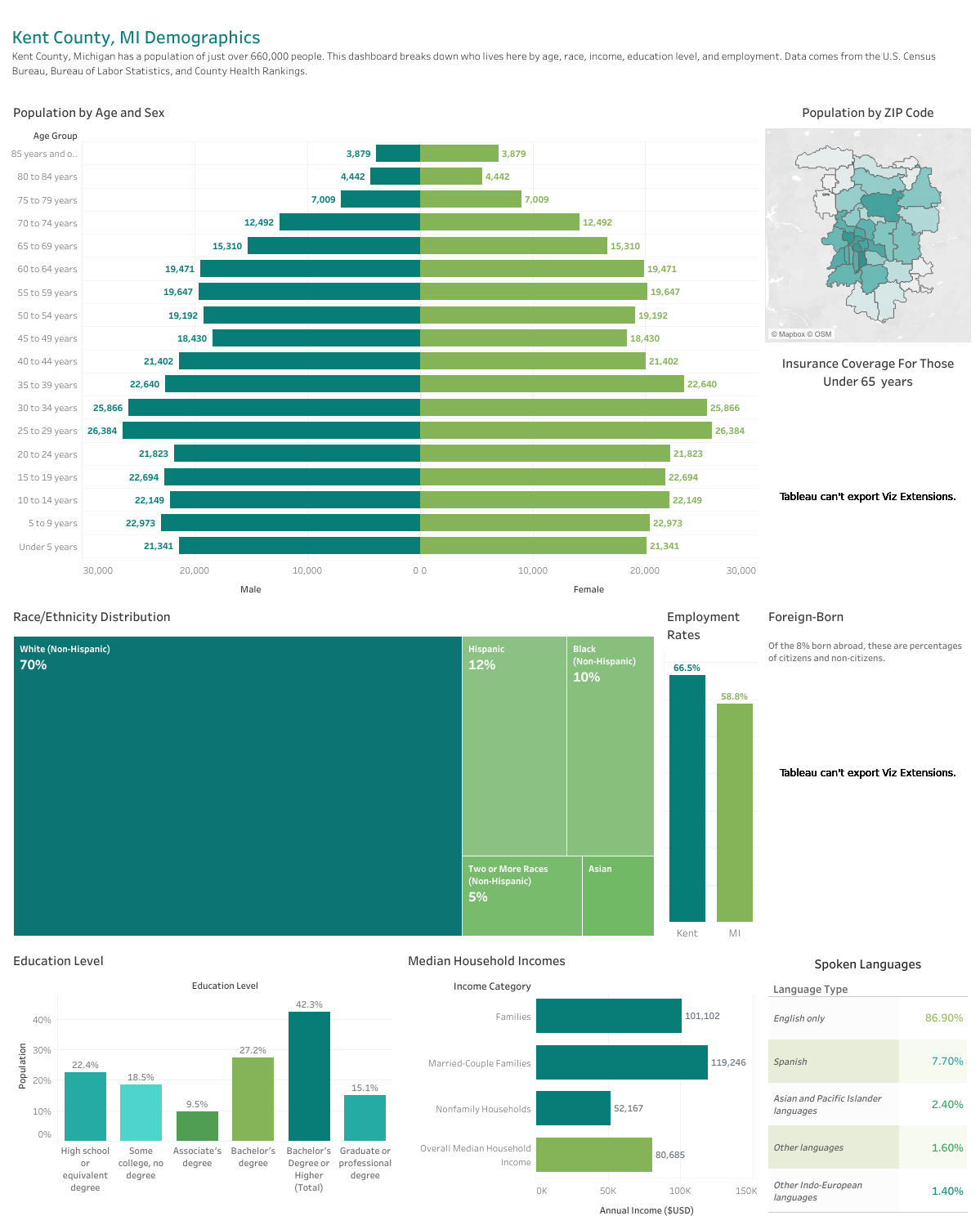
Population distribution, age structure, race and ethnicity, income, language, gender pay gap, and educational attainment. Kent County is 70% white with a median household income of $80,685, above state and national figures, but that average obscures significant variation across communities.
View on Tableau Public
Dashboard 02
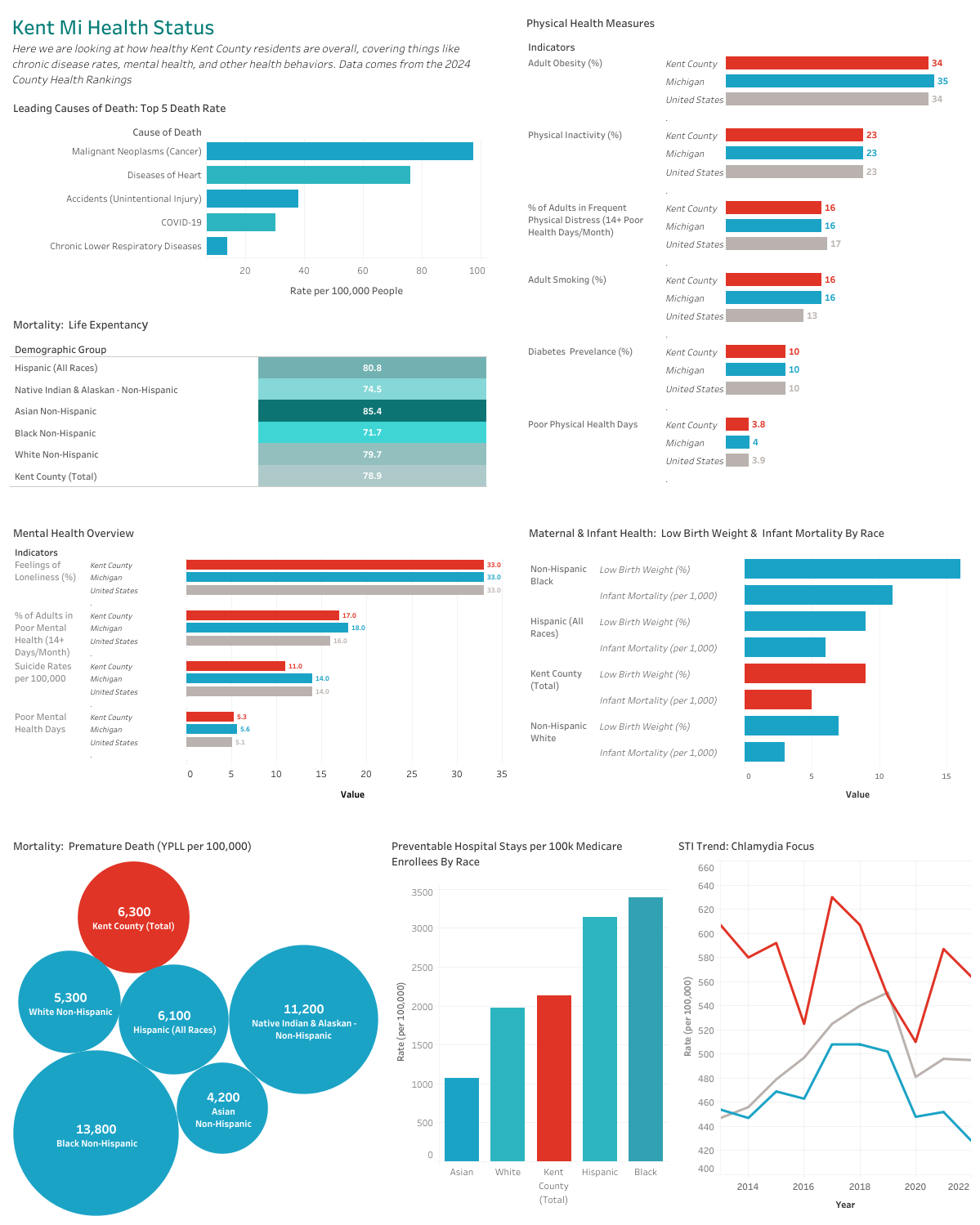
Mortality rates, life expectancy by race and ethnicity, chronic disease prevalence, maternal and infant health indicators, and STI trends benchmarked against state and national averages. Cancer is the leading cause of death at nearly 100 per 100,000, followed by heart disease at 76 per 100,000.
View on Tableau Public
Dashboard 03
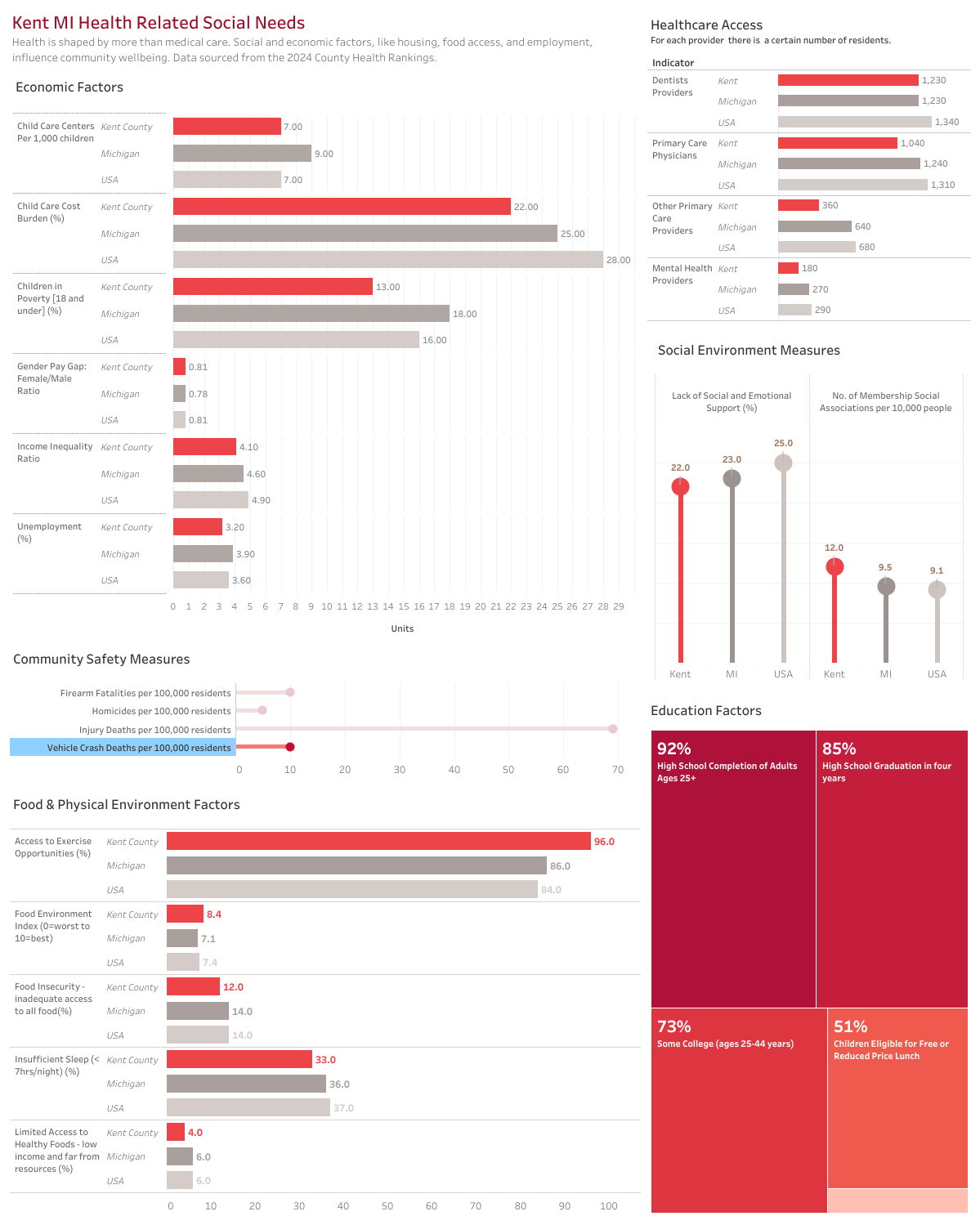
Food insecurity, housing instability, childcare access, child poverty, and social and emotional support. 51% of children qualify for free or reduced price lunch, only 7 childcare centers per 1,000 children versus the state average of 9, and 22% of residents lack social and emotional support.
View on Tableau PublicKey Findings
From a surface level, Kent County performs well compared to state and national benchmarks. But the numbers make clear that not everyone is experiencing the same county. The distance between the best and worst outcomes is too large to look past.
Asian residents live to 85.4 years on average while Black residents live nearly 14 years less. African American infant mortality is more than three times that of white children at 11 per 1,000, and low birth weight among Black children is double the white rate. Native American and Alaskan residents face double the premature death rate of most other groups.
Kent County has strong provider-to-patient ratios and well-resourced mental health infrastructure including PineRest and Forest View hospitals. Yet African American and Hispanic communities are hospitalized for preventable conditions at over 3,000 per 100,000 Medicare enrollees, nearly three times the Asian rate of 1,075. Better access is not producing equitable outcomes.
Chlamydia rates have been above state and national averages for over a decade and continue to rise. Free testing is available through the Personal Health Services Clinic. The issue is not infrastructure. It is outreach, particularly toward the large college-aged population across Calvin University, Davenport, and GVSU campuses.
13% of children under 18 live in poverty and 51% qualify for free or reduced price lunch. There are only 7 childcare centers per 1,000 children versus the state average of 9, and 7% of youth aged 16 to 19 are neither working nor in school. These pressures compound into long-term health outcomes that are harder to reverse.
Community Health Improvement Plan
Kent County already has a strong foundation: 12 membership social associations per 10,000 people versus 9.5 statewide, and a network of community organizations people genuinely trust. These recommendations build on that rather than starting from scratch.
Corewell Health Butterworth and Trinity Health need to examine how their obstetric staff engages with Black and Hispanic patients, expand doula programs so mothers have advocates with them in clinical settings, and coordinate more closely with WIC to catch warning signs before delivery. Black and Hispanic women have said consistently that they do not feel listened to, and the infant mortality numbers reflect that directly.
Target: halve the racial gap in infant mortality and low birth weight within five yearsHaving providers available does not mean much if getting to one requires a car, fluent English, or money that residents do not have. Hospitals should partner with community organizations, churches, and libraries that people already trust, and bring screening and referrals to those spaces. A school-based program targeting the 51% of children eligible for free or reduced price lunch would directly address the youth mental health gap.
Target: measurable increase in service utilization among underserved ZIP codesThe WISEWOMAN program does important work for women's cardiovascular health but leaves out half the population. Heart disease is the second leading cause of death in the county, and African American and Hispanic men face higher premature death rates than most other groups. Corewell Health should develop an equivalent program delivered through barbershops and recreation centers that already serve as trusted gathering points.
Target: reductions in blood pressure and cholesterol among enrolled participantsFree testing is available but chlamydia rates keep climbing. Young adults aged 18 to 35 are the group most affected, and Kent County's large college population is a direct channel that is not being used. Hospitals and the health department should partner with local universities to normalize sexual health conversations on campus rather than waiting for students to seek out a clinic.
Target: declining chlamydia rate relative to state and national benchmarks within three yearsWritten Report
The written report synthesizes all three dashboards into a single narrative covering community demographics, current service offerings, key health findings, and a full Community Health Improvement Plan with measurable KPIs. Written in APA 7 format for HC604: Hospital Analytics at Clarkson University, March 2026.
Download Report